
SaaS vs. PaaS vs. IaaS vs. FaaS vs. DaaS: What’s the Difference?
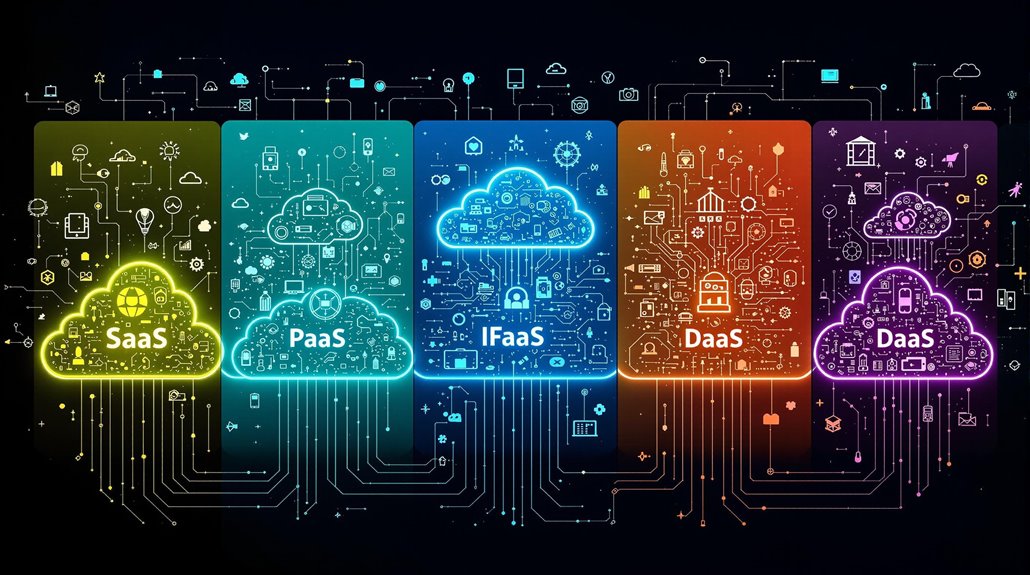
To understand cloud service differences, consider SaaS as user-ready apps like Gmail for seamless online access. PaaS offers a platform for developing apps with built-in tools, easing the creation process. IaaS provides scalable virtual resources without upfront costs, giving you control over infrastructure. FaaS runs individual functions in response to events, optimizing resources while charging only for what's used. DaaS delivers virtual desktops accessible from anywhere, ensuring flexibility and centralized management. Knowing these services helps you choose the right solution for your needs, enhancing efficiency and productivity. Curious to learn which service suits your goals best?
Key Takeaways
- SaaS delivers ready-to-use applications over the internet without the need for local installation or maintenance.
- PaaS provides a development environment for building, testing, and deploying applications with integrated tools and database management.
- IaaS offers virtualized computing resources, granting extensive customization and control over infrastructure needs.
- FaaS executes individual functions in response to events, optimizing resource efficiency through automatic scaling.
- DaaS supplies virtual desktops accessible from any internet-connected device, simplifying management and enhancing security.
Understanding SaaS
Understanding SaaS is crucial in today's cloud-driven world. As a user, you benefit from this cloud computing service by accessing software via the internet without the hassle of installation or maintenance. SaaS operates on a subscription-based model, making it affordable and flexible since you pay monthly or yearly without hefty upfront costs. Applications like GMAIL, MailChimp, and Shopify illustrate the diverse range of functionalities SaaS provides, from managing emails to running e-commerce platforms.
With SaaS, you enjoy the convenience of internet connectivity, allowing you to access applications from any device, anywhere. This flexibility fosters collaboration, as you and your team can work together seamlessly, regardless of location.
Another advantage is that your software is always up-to-date. SaaS providers handle automatic updates, ensuring you have access to the latest features and security enhancements without lifting a finger.
Moreover, the service provider manages crucial aspects of the software, including security and performance, allowing you to focus on using the application rather than maintaining it. By leveraging SaaS, you streamline your operations, enhance productivity, and embrace the future of software in an increasingly interconnected world.
Exploring PaaS
Exploring PaaS, you'll discover a powerful solution for developers seeking to build, test, and deploy applications efficiently without the hassle of managing underlying infrastructure.
With Platform as a Service (PaaS), you're provided with a comprehensive environment that streamlines application development. PaaS solutions like Google App Engine and Heroku offer integrated development tools, database management, and middleware, which simplifies the entire process.
One of the standout features of PaaS is its support for multiple programming languages and frameworks, giving you the freedom to use your preferred technologies. This flexibility is crucial for tailoring applications to your specific needs.
Moreover, PaaS is particularly advantageous for collaborative projects. It enables multiple developers to work on the same application simultaneously, regardless of their locations, facilitating seamless teamwork and innovation.
PaaS also provides cost efficiency by reducing upfront costs with a pay-per-use model, which minimizes barriers to entry for developers and businesses alike.
Delving Into Iaas

As you shift from the streamlined environment of PaaS, you'll find Infrastructure as a Service (IaaS) offers a different kind of flexibility and control. With IaaS, you're renting virtualized computing resources over the internet, giving you the ability to manage servers, storage, and networking without investing in physical hardware.
This setup is perfect for businesses that need rapid scalability and customization. You can configure your virtual machine and storage to match your business requirements precisely.
IaaS providers like Microsoft Azure and Google Cloud offer scalable and flexible infrastructure solutions, catering to businesses with fluctuating resource demands. The cost-saving benefits of IaaS are significant, thanks to its pay-as-you-go pricing model. You only pay for the resources you use, eliminating the need for hefty upfront capital investments in physical infrastructure.
This model is particularly advantageous for startups and enterprises that experience varying workloads.
Moreover, IaaS allows you greater control compared to more abstracted models like SaaS and PaaS. You manage and customize your virtual environments, which is ideal if your business needs specific configurations.
Embrace the power of IaaS to optimize your infrastructure and maximize your operational efficiency. Additionally, Google Cloud Platform provides configurable virtual machines with high-performance options, enabling users to tailor their infrastructure to specific workload demands.
Discovering FaaS
While diving into the world of cloud computing, you'll discover that Function as a Service (FaaS) offers a revolutionary approach to deploying code. This model lets developers run individual functions in response to events, without managing servers or infrastructure. FaaS, a key component of the cloud, empowers you to focus on writing code while leaving operational concerns behind.
FaaS operates through an event-driven architecture, where functions are triggered by specific events like HTTP requests or data changes. This enhances resource efficiency and scalability, as functions only run when needed. The beauty of FaaS lies in its pay-as-you-go pricing model, making it cost-effective since you pay solely for the compute time used during execution.
Consider these FaaS benefits:
- AWS Lambda: One of the most popular FaaS offerings, it automatically scales and includes built-in fault tolerance.
- Microservices architecture: FaaS fits seamlessly into microservices, enabling the creation of loosely coupled functions.
- Resource efficiency: Only running functions when triggered conserves resources.
- Event-driven focus: Respond to real-time events with precision.
- Cost-effectiveness: Ideal for variable workloads, reducing unnecessary expenses.
With FaaS, developers can enhance efficiency and scalability, making it a game-changer in modern cloud applications. The introduction of automatic scaling in FaaS platforms ensures that applications can handle varying loads effectively, much like in PaaS environments.
Analyzing DaaS

In the realm of cloud computing, Desktop as a Service (DaaS) represents a pivotal shift towards more flexible and secure computing environments. DaaS offers virtual desktops hosted in the cloud, enabling users to access their desktops from any internet-connected device via a web browser. This means you can work seamlessly from anywhere, without being tethered to a physical machine.
The centralized management of DaaS ensures that applications and data are stored in one secure location. This setup simplifies updates and maintenance, offering a streamlined alternative to traditional desktop environments.
Scalability is a significant advantage of DaaS. You can quickly provision virtual desktops, allowing new employees to access necessary resources right from their first day. This ability to scale resources up or down as needed helps organizations remain agile and responsive to changing demands.
Another key aspect is the security benefits. With sensitive data stored in the cloud, the risk associated with lost or stolen devices is greatly reduced, providing peace of mind.
However, managing DaaS can come with licensing complexity. Each virtual desktop often requires individual licensing, which can complicate IT management and budgeting. Navigating these complexities is essential for efficient cloud services deployment. One of the key benefits of cloud delivery is significant cost savings by avoiding upfront hardware investments.
Comparing Cloud Models
Navigating the diverse landscape of cloud computing models is crucial for selecting the right solution for your business needs. Each model—SaaS, PaaS, IaaS, FaaS, and DaaS—offers unique benefits tailored to different operational demands. Understanding these differences helps you leverage cloud services effectively.
- SaaS: Software as a Service provides ready-to-use applications like MailChimp and Google Drive, eliminating the need for local installation and management.
- PaaS: Platform as a Service, exemplified by Heroku and Google App Engine, offers a development environment that allows you to focus on building applications without worrying about the underlying infrastructure.
- IaaS: Infrastructure as a Service, such as AWS EC2 and Azure VM, delivers scalable virtualized resources, enabling flexible IT resource management on a pay-as-you-go basis.
- FaaS: Function as a Service operates on a serverless model, allowing you to execute code in response to events without managing servers, with AWS Lambda as a key example.
- DaaS: Desktop as a Service provides virtual desktops that facilitate remote work and centralized management, highlighted by services like Urban Mapping and Xignite.
- Unlike other models, IaaS offers extensive customization, granting full control over infrastructure, which is beneficial for organizations needing granular management of IT resources.
Choosing the Right Model

Selecting the right cloud computing model can significantly impact your business's efficiency and adaptability. When deciding which service to go for, think about your specific needs and how each model can address them.
SaaS is perfect if you're looking for user-friendly solutions with minimal IT upkeep. It's an excellent choice for small businesses where users access software without worrying about managing applications. SaaS platforms provide scalable solutions tailored for SMB needs, offering continuous updates, data security, and compliance managed by providers, allowing for quick adaptation to market changes.
If your focus is on developing new applications, PaaS might be your best bet. It provides collaborative development tools and supports various programming languages, ideal for teams of developers. This service helps streamline application creation without the hassle of managing underlying infrastructure.
For organizations needing full control over infrastructure, consider IaaS. It offers customization and scalability, making it suitable for larger enterprises or those with specific workload demands.
If your applications benefit from event-driven architecture, FaaS allows you to execute code on demand without managing servers, optimizing resource efficiency.
Lastly, DaaS offers flexible access to virtual desktops, proving advantageous for businesses with remote work environments or dynamic workforce needs.
Related posts