
How to Analyze SaaS Revenue Streams for Better Insights

To gain deeper insights into your SaaS revenue streams, focus on key metrics like Monthly Recurring Revenue (MRR), churn rate, Customer Lifetime Value (CLV), and Customer Acquisition Cost (CAC). These metrics are essential for understanding your financial health, informing pricing strategies, and guiding customer segmentation.
However, tracking these numbers alone is insufficient. It's crucial to delve into the nuances of each metric and their interdependencies.
Hidden insights within your data could significantly influence your growth trajectory.
Understanding SaaS Revenue Streams
Understanding SaaS revenue streams is crucial for optimizing business potential and ensuring steady cash flow. Central to these revenue streams are subscription fees, typically structured as monthly or annual payments, which provide predictable income. Various SaaS revenue models, such as tiered pricing, per-user pricing, and usage-based pricing, cater to different customer needs.
Key metrics like Customer Acquisition Cost (CAC) and Customer Lifetime Value (CLV) are essential for evaluating the profitability of marketing strategies. Additionally, monitoring churn rate is significant, as a high churn rate often indicates issues with customer satisfaction and retention.
To enhance overall profitability, consider diversifying your revenue streams. Implement strategies like upselling or offering complementary services to boost customer engagement and loyalty.
Focusing on these elements enables the creation of robust financial forecasting models, supporting sustainable growth and resilience against market fluctuations. Ultimately, mastering these revenue streams empowers you to make informed decisions that drive your SaaS business forward.
Key Metrics for Analysis
When evaluating key metrics for your SaaS business, Monthly Recurring Revenue (MRR) and Churn Rate are essential indicators. MRR allows you to monitor your consistent income, while Churn Rate measures your effectiveness in retaining customers.
Monthly Recurring Revenue (MRR)
Monthly Recurring Revenue (MRR) is a vital metric for predicting cash flow and assessing business growth driven by subscription income. To calculate MRR, sum the recurring revenue from all active subscriptions, incorporating any upgrades, downgrades, and new customer acquisitions during the month. This metric offers a clear view of your financial health and helps identify trends in customer acquisition and retention.
Analyzing MRR trends can uncover insights into customer growth patterns and seasonal variations. An increase in MRR typically signifies effective customer acquisition strategies, while a decline may indicate issues with customer retention or competitive pricing.
It's essential to evaluate MRR alongside other metrics like Customer Acquisition Cost (CAC) and churn rates to gain a comprehensive understanding of your SaaS business's profitability.
Churn Rate Analysis
Churn rate analysis is crucial for identifying customer satisfaction issues and refining retention strategies in your SaaS business. The churn rate, calculated by dividing the number of customers lost during a specific period by the total number of customers at the start of that period, provides key insights into your financial health. A high churn rate can indicate dissatisfaction or a perceived lack of product value, making regular monitoring essential.
Understanding your churn rate is fundamental for optimizing revenue growth, as it directly affects Customer Lifetime Value (CLV). A lower churn rate typically leads to longer customer lifespans, thereby increasing total revenue. By analyzing churn patterns, you can gain insights into customer behavior, enabling you to tailor your subscription fee structures and retention strategies more effectively.
Industry benchmarks suggest aiming for an annual churn rate below 5%, with high-growth companies often targeting even lower rates. By addressing the underlying causes of customer attrition, you can enhance customer satisfaction and drive sustainable revenue growth.
Regularly reviewing your churn metrics will empower you to make data-driven decisions, ensuring your SaaS business remains competitive and profitable.
Types of Revenue Models
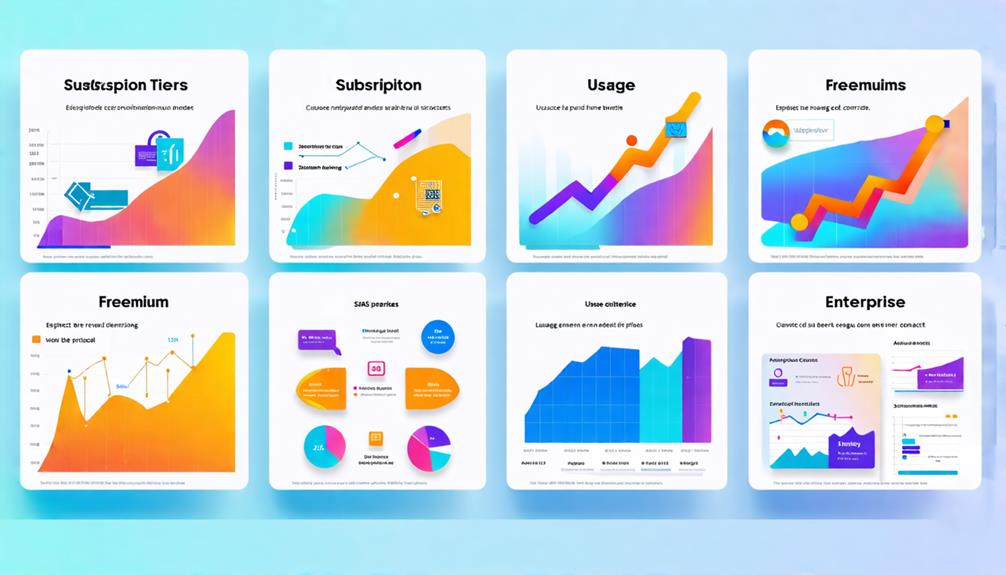
In today's competitive SaaS landscape, understanding the various revenue models is essential for maximizing profitability and addressing customer needs. Each model serves distinct purposes, allowing you to tailor your strategy to different customer segments.
| Revenue Model | Key Features | Benefits |
|---|---|---|
| Subscription Model | Recurring fees (monthly or annually) | Predictable income streams and customer retention |
| Freemium Model | Basic functionality for free | Drives upselling opportunities |
| Usage-Based Pricing | Charges based on actual consumption | Promotes transparency and scalability |
| Tiered Pricing | Multiple packages for different needs | Maximizes revenue potential |
| Flat-Rate Pricing | Single, fixed fee | Simplifies billing and improves customer satisfaction |
The Subscription Model provides a steady stream of income, enhancing financial predictability and customer retention. Freemium Models attract users by offering free access to basic features, encouraging them to upgrade for additional functionality. Usage-Based Pricing allows customers to pay based on their actual usage, fostering transparency and scalability. Tiered Pricing offers multiple packages tailored to various customer needs, thereby maximizing revenue potential. Lastly, the Flat-Rate Pricing Model simplifies billing, enhancing customer satisfaction.
Sales Approaches in SaaS
When selecting a sales approach for your SaaS product, you'll typically consider two main models: low-touch and high-touch. The low-touch model leverages automation to streamline the sales process, whereas the high-touch model focuses on personalized interactions. Understanding these models will help you align your strategy with your product's complexity and your target market's needs.
Low-Touch Sales Model
The low-touch sales model leverages automation tools to streamline customer acquisition, enabling efficient scaling with minimal personal interaction. This approach is particularly effective for SaaS products with straightforward functionalities, making it ideal for lower-priced subscription sales where high-volume transactions are expected.
By adopting the low-touch sales model, you can significantly reduce customer acquisition costs (CAC), as it requires less investment in sales personnel and personalized outreach resources.
A streamlined purchasing process allows potential customers to engage with your product at their convenience, often leading to higher conversion rates. Customers appreciate a self-service environment where they can access product information and support immediately, which aligns with modern consumer expectations and fosters trust.
Furthermore, analyzing your SaaS revenue streams through this model provides valuable financial insights, highlighting areas for improvement and growth. Embracing a low-touch sales strategy not only optimizes your operations but also positions you to effectively meet the evolving needs of your customers.
High-Touch Sales Model
Switching from the efficiency of a low-touch sales model, the high-touch sales model emphasizes building personalized relationships to address complex customer needs in the SaaS landscape. In this approach, dedicated account managers engage in individualized interactions, ensuring clients receive customized solutions that align with their specific requirements. This model is particularly effective for high-value subscription services, where customer satisfaction is crucial for retention.
Although the high-touch sales model can result in a higher customer acquisition cost (CAC) due to the significant resources required, the benefits often outweigh the initial investment. By fostering strong relationships, companies can significantly increase customer lifetime value (CLV) and justify premium pricing for their services.
The personalized attention also helps reduce churn rates, as satisfied customers are more likely to remain loyal.
Pricing Strategies Overview
SaaS companies employ various pricing strategies to address diverse customer needs and optimize revenue streams. Selecting the appropriate pricing model is crucial for enhancing your SaaS revenue and expanding your customer base. One widely adopted strategy is tiered pricing, which offers multiple subscription levels to cater to different customer segments and maximize upselling opportunities.
Per-user pricing is another effective approach, charging based on the number of users accessing your software. This model aligns costs with actual usage, making it especially advantageous for growing teams. Alternatively, usage-based pricing ensures customers pay only for what they consume, promoting transparency and flexibility in service delivery.
Freemium models can be powerful for customer acquisition, providing basic access for free while encouraging users to upgrade for premium features. If managed well, this strategy can significantly improve retention rates.
Regular analysis of financial data is essential to ensure that your pricing strategies align with your overall business objectives. By carefully selecting and optimizing these pricing strategies, you can enhance customer satisfaction and drive sustainable growth in your SaaS business.
Cost Structures and Profitability
Understanding cost structures is crucial for optimizing profitability in a SaaS business. Profitability hinges on balancing total revenues from subscription fees against the costs of delivering the service, including Customer Acquisition Cost (CAC) and churn-related expenses. By analyzing cost structures, businesses can pinpoint areas for expense reduction while enhancing service value.
Monitoring key metrics like Customer Lifetime Value (CLV) in relation to CAC is essential. This comparison helps gauge profit margins' sustainability and assess marketing effectiveness. Regular evaluations of gross margins offer insights into financial health, highlighting potential areas for improvement.
A tiered pricing strategy can further enhance revenue potential. By aligning pricing with the perceived value delivered to different customer segments, businesses can boost profitability while meeting diverse needs.
Ultimately, a clear understanding of cost structures informs pricing strategies and strengthens overall financial health. Focusing on these elements enables the creation of a sustainable SaaS model that optimizes revenue and minimizes unnecessary expenses.
Customer Segmentation Techniques

Customer segmentation techniques categorize users into distinct groups based on shared characteristics, enabling tailored marketing strategies for optimal impact. By gaining deeper insights into your customers, you can enhance both acquisition and retention efforts.
Here are three effective segmentation methods:
- Demographic Segmentation: Categorize users by age, gender, or location to refine your messaging.
- Behavioral Segmentation: Examine purchasing patterns and engagement levels to identify high-value customer groups.
Employing data-driven segmentation aids in creating targeted campaigns that address specific customer pain points and enhance loyalty. Regularly analyzing these segments allows for continuous adjustment of marketing approaches, ensuring alignment with audience needs. This adaptability can lead to increased Monthly Recurring Revenue (MRR) by focusing on the most profitable segments.
Ultimately, these segmentation techniques enable the creation of more personalized experiences, fostering stronger customer relationships and driving sustainable growth.
Strategies for Revenue Growth
Effective revenue growth strategies can transform your business by leveraging diverse pricing models and enhancing customer engagement. By implementing tiered pricing models, which cater to various customer segments, you can maximize your SaaS revenue potential. Offering different levels of access and features based on user needs encourages more customers to choose your product.
Utilizing usage-based pricing fosters transparency and fairness, leading to higher engagement as customers pay only for what they use. Regularly analyzing key metrics like Monthly Recurring Revenue (MRR) and Customer Acquisition Cost (CAC) enables you to refine your marketing strategies and improve customer retention.
Diversification is essential. Consider introducing complementary products or professional services to mitigate risks associated with market fluctuations and increase overall profitability. Additionally, investing in customer success programs and personalized experiences can significantly boost customer retention rates, which are critical for sustaining and growing your recurring revenue.
Tools for SaaS Revenue Analysis

Leveraging the right tools for SaaS revenue analysis can significantly enhance your ability to track performance and make data-driven decisions. These tools provide insights into critical metrics like Monthly Recurring Revenue (MRR), Customer Acquisition Cost (CAC), and churn rate, which are essential for maintaining strong financial health.
Key Tools for SaaS Revenue Analysis:
- Baremetrics: Delivers real-time insights into key SaaS metrics, enabling effective performance monitoring.
- ChartMogul: Integrates with payment processors to visualize revenue trends and customer behavior, aiding in long-term user engagement analysis.
These tools not only automate revenue recognition but also provide detailed analytics on subscription metrics. This allows for the refinement of marketing strategies and optimization of revenue streams.
Conclusion
In conclusion, analyzing SaaS revenue streams is crucial for driving growth and profitability. By focusing on key metrics such as Monthly Recurring Revenue (MRR), churn rate, and Customer Lifetime Value (CLV), you can gain valuable insights into your business performance.
Implementing effective pricing strategies and understanding customer segments enables you to tailor your offerings to meet diverse needs. Regular use of analytics tools helps you track trends and refine your marketing strategies, ensuring continuous improvement and sustained success.