What Types of Businesses Can Benefit From Saas?

If you're considering how SaaS can enhance your operations, you might wonder which types of businesses stand to gain the most. From startups aiming to streamline their processes to large enterprises seeking operational efficiency, SaaS offers tailored solutions across diverse sectors. E-commerce platforms can simplify management tasks, while creative agencies can boost collaboration. Understanding the nuances of how different organizations can effectively utilize these tools is crucial. What might be the best fit for your specific needs? Let's investigate the possibilities further.
Startups and Small Businesses
Startups and small businesses can harness the power of SaaS solutions to reduce costs and streamline operations, fostering growth in a competitive landscape. SaaS significantly lowers upfront expenses by eliminating the need for costly hardware or software licenses. The subscription model allows businesses to pay only for what they use, facilitating easy scaling as business needs evolve.
SaaS applications are designed with user-friendly interfaces that require minimal IT expertise, enabling business owners to concentrate on core activities rather than intricate software management. This efficiency is crucial for startups where time and resources are limited. Additionally, SaaS supports remote work, allowing team members to access essential tools from any device with internet connectivity. This flexibility is vital for small businesses with distributed teams.
Furthermore, continuous software updates managed by the SaaS provider ensure access to the latest features and security measures without additional costs or maintenance efforts. By adopting SaaS, startups can operate more efficiently and adapt swiftly to changing market conditions.
Enterprises and Corporations
For enterprises and corporations, SaaS solutions streamline operations and enhance efficiency. The subscription-based models not only facilitate cost management and savings but also enable optimal resource allocation. Furthermore, advanced collaboration and communication tools empower teams to work cohesively, regardless of their location.
Streamlined Operations and Efficiency
Adopting SaaS solutions can significantly streamline enterprise operations and enhance efficiency by providing real-time access to essential data and tools. These solutions facilitate quicker decision-making and seamless team collaboration. The automation features of SaaS applications eliminate repetitive tasks, potentially boosting productivity by up to 30%.
Additionally, SaaS offers flexible scalability, allowing you to adjust subscriptions according to business needs. This adaptability enables swift responses to market demands without substantial upfront investments. Operational costs are also reduced, as the SaaS provider handles updates and security, minimizing the need for extensive IT infrastructure and maintenance.
A recent study indicates that organizations utilizing SaaS solutions experience a 20% reduction in time spent on manual processes, resulting in faster project completion and improved overall operational efficiency. This allows more focus on core business functions. Leveraging SaaS can optimize operations and drive effective enterprise growth.
Cost Management and Savings
By streamlining operations and enhancing efficiency, SaaS solutions significantly contribute to cost management and savings for enterprises. These solutions eliminate the need for substantial upfront investments in hardware and software licensing, potentially reducing IT expenditures by up to 30% annually.
Additionally, subscription-based pricing allows you to pay only for the services and features you actually need, facilitating better resource allocation and financial management, particularly during fluctuating demand periods. SaaS applications don't incur extra costs for routine maintenance, updates, or security patches. This enables you to streamline your budgets and reallocate resources toward strategic initiatives, saving substantial operational costs.
Adopting SaaS also means avoiding the expenses associated with hiring extensive IT support staff for software management, potentially reducing total staffing costs by up to 25%. Furthermore, the scalability of SaaS solutions allows you to adjust service levels as your business grows, preventing overpayment for unused resources and ensuring operational costs align with actual usage. Embracing SaaS not only improves efficiency but also empowers you to manage costs effectively, thereby maximizing your organization's financial health.
Enhanced Collaboration and Communication
SaaS tools like Microsoft Office 365 and Google Workspace empower teams to collaborate effortlessly, enabling real-time document sharing and simultaneous editing. This enhances productivity across the board. SaaS applications integrate chat, video conferencing, and project management features into one cohesive platform, improving both collaboration and communication within your organization. This integration not only streamlines workflows but also significantly reduces the time spent on email communication, facilitating quicker decision-making processes.
Over 80% of organizations are already leveraging cloud-based collaboration tools, ensuring that teams stay connected regardless of their location. Additionally, SaaS solutions often provide analytics and reporting features, offering insights into team collaboration metrics. This data helps identify areas for improvement and fosters a more engaged workforce.
E-commerce Platforms
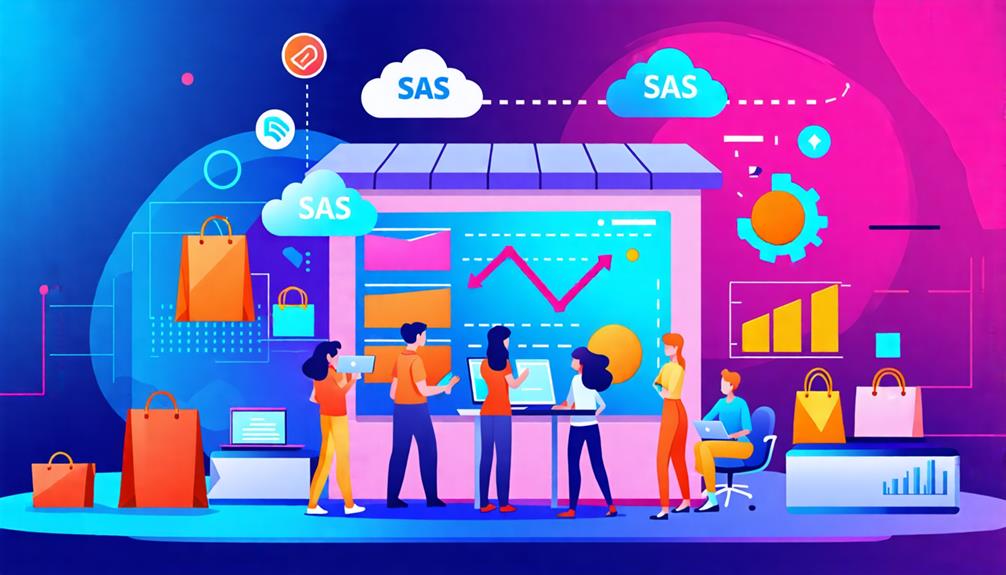
Many businesses find that e-commerce platforms like Shopify and BigCommerce offer an efficient way to launch and manage online stores without requiring extensive technical skills. These SaaS solutions provide scalable options, allowing you to expand product listings and handle increased traffic without significant upfront costs.
Here's a quick comparison of key features:
| Feature | Benefits |
|---|---|
| Built-in Payment Processing | Simplifies transactions for customers |
| Inventory Management | Streamlines stock tracking |
| Customer Relationship Management | Enhances customer engagement |
| Data-Driven Decisions | Enables informed sales strategies |
E-commerce platforms enable online retailers to concentrate on their business while the technology manages the complex operations. With real-time analytics and reporting, you can make data-driven decisions that enhance customer experiences and boost sales. As the global e-commerce market is projected to reach $6.39 trillion by 2024, leveraging these SaaS solutions becomes essential for maintaining competitiveness. Adopting e-commerce platforms not only simplifies operations but also sets your business up for future growth.
Creative Agencies
As a creative agency, you understand the critical role of streamlined project management and effective collaboration. SaaS tools enhance your team's efficiency and communication, enabling seamless project management from any location. These solutions not only simplify workflows but also maintain real-time connectivity with clients and team members.
Streamlined Project Management
Leveraging project management tools like Asana and Monday.com can significantly enhance collaboration and streamline workflows for creative agencies. By integrating SaaS software, you can improve your team's productivity and project visibility.
Here are three core benefits:
- Real-time updates: These platforms provide instant notifications for task assignments and changes, enabling your team to quickly adapt to client feedback.
- Cloud-based tools: As remote work becomes more prevalent, these tools ensure seamless communication among team members, fostering a flexible and collaborative work environment.
- Integration capabilities: Many SaaS project management solutions effortlessly integrate with other applications, such as time tracking and invoicing tools, maintaining a cohesive workflow and reducing administrative overhead.
Enhanced Collaboration Tools
Effective collaboration tools are essential for creative agencies, enabling teams to work together seamlessly and efficiently on multiple projects. By leveraging SaaS platforms like Adobe Creative Cloud, agencies gain access to a suite of design applications and cloud storage solutions that enhance teamwork and streamline file sharing, ensuring that everyone remains connected and productive.
Platforms such as Slack facilitate real-time communication and project management, simplifying collaboration across diverse projects and client engagements. Tools like Trello and Asana allow for efficient task organization, project tracking, and responsibility assignment, leading to improved workflow management and accountability within teams.
Utilizing cloud-based platforms like Google Workspace enables your agency to collaborate on documents, spreadsheets, and presentations in real-time, significantly boosting productivity. Research indicates that teams using collaborative SaaS tools can experience up to a 30% increase in productivity. This is crucial for creative agencies aiming to deliver high-quality projects efficiently. Incorporating these collaboration tools not only enhances teamwork but also sustains the creative flow, ensuring your agency remains competitive in a fast-paced environment.
Educational Institutions

Educational institutions can significantly enhance their teaching and administrative processes by adopting SaaS solutions tailored to their specific needs. Utilizing cloud-based tools can improve both learning experiences and operational efficiency. Here's how SaaS can benefit your institution:
- Learning Management Systems (LMS): Platforms like Canvas and Moodle enable seamless online course delivery, facilitating student engagement and effective course management.
- Student Information Systems (SIS): These systems streamline enrollment, grading, and attendance management, improving operational efficiency and allowing educators to focus on teaching.
- Analytics and Reporting: Many SaaS applications offer robust analytics tools that help track student performance, identify areas for improvement, and support data-driven decision-making.
The scalability of SaaS solutions allows for easy adjustment based on enrollment fluctuations or evolving educational needs. This adaptability ensures a high-quality educational experience without a significant upfront investment. Embracing SaaS empowers institutions to innovate and respond to the changing educational landscape effectively.
Healthcare Organizations
Healthcare organizations can significantly enhance patient care and operational efficiency by leveraging SaaS solutions tailored to their unique needs. Through electronic health record (EHR) management, you can access patient data in real-time, improving care coordination across departments. This level of integration ensures that all healthcare providers involved in patient care are aligned, which is crucial for effective treatment.
SaaS applications also facilitate telemedicine services, enabling remote consultations and follow-ups. This is particularly advantageous for patients in rural areas who might otherwise face challenges in accessing care. Additionally, many SaaS platforms offer advanced analytics tools that help your organization track patient outcomes and optimize operational efficiency while ensuring compliance with regulatory requirements such as HIPAA.
Furthermore, secure data storage and backup options provided by SaaS solutions protect sensitive patient information from data breaches. Utilizing SaaS for practice management streamlines administrative tasks, including appointment scheduling, billing, and insurance claims processing. This not only enhances operational efficiency but can also result in significant cost savings for your healthcare organization. Adopting SaaS solutions is a strategic step toward superior patient care and improved operational capabilities.
Nonprofit Organizations

Nonprofit organizations can significantly enhance their operations by adopting SaaS solutions that optimize donor engagement and streamline fundraising efforts. Leveraging cloud-based tools enables improved donor relationships and ensures more resources are dedicated to the organization's mission.
Here are three key benefits of SaaS for nonprofit organizations:
- Streamlined Operations: SaaS applications can reduce administrative costs by up to 30%, allowing more funds to be directed toward core activities.
- Enhanced CRM Systems: SaaS-based CRM systems facilitate better tracking of volunteer management and event planning, improving coordination among team members and stakeholders.
- Scalability and Advanced Analytics: The scalability of SaaS allows for service adjustments based on donor contributions. Additionally, access to advanced analytics aids in measuring impact and maintaining accountability to stakeholders.
Conclusion
In today's fast-paced environment, businesses across various sectors can benefit from SaaS solutions. Whether you're a startup seeking cost-effective tools, a large enterprise aiming for streamlined operations, or a nonprofit organization focused on enhancing engagement, there's a SaaS solution tailored to your needs. Adopting these tools not only optimizes processes but also fosters collaboration and boosts productivity. Don't delay—explore how SaaS can elevate your business and fulfill your unique requirements today!