
How to Use Net Promoter Score (NPS) to Improve SaaS

Leveraging Net Promoter Score (NPS) can significantly enhance your SaaS business by offering deep insights into customer satisfaction. Regularly surveying your users to assess their likelihood of recommending your service allows you to categorize responses and understand overall sentiment.
Engaging with both Detractors and Promoters is crucial. However, it's not just about collecting scores—it's about acting on the feedback you receive. By implementing these insights, you can identify key actions that will boost customer loyalty and retention.
Let's explore how to achieve this.
Understanding Net Promoter Score
Understanding the Net Promoter Score (NPS) is crucial for assessing customer loyalty and satisfaction in your SaaS business. NPS gauges how likely your customers are to recommend your product on a scale from 0 to 10. Based on their scores, customers are classified into three groups: Promoters (9-10), Passives (7-8), and Detractors (0-6). This classification provides valuable insights into your customer base.
To calculate NPS, subtract the percentage of Detractors from the percentage of Promoters. The resulting score ranges from -100 to 100. A score above 0 indicates more Promoters than Detractors. As of 2023, the average NPS score for SaaS companies is between 31 and 50, with scores above 50 considered excellent, signifying strong customer loyalty.
Effectively using NPS can help you identify areas for improvement. By analyzing the feedback behind the scores, you can implement actionable steps to enhance customer satisfaction and loyalty. NPS serves as a valuable benchmark to compare your performance against industry standards and cultivate a more loyal customer base.
Importance of NPS for SaaS
Understanding the importance of Net Promoter Score (NPS) for your SaaS business is crucial. NPS allows you to measure customer loyalty accurately, benchmark your performance against competitors, and drive revenue growth.
Measuring Loyalty Effectively
Measuring customer loyalty is crucial for SaaS companies, and the Net Promoter Score (NPS) provides a reliable method for capturing this key metric. NPS surveys assess customer satisfaction and loyalty with a single, impactful question: 'How likely are you to recommend our product?' Respondents are classified into Promoters, Passives, and Detractors, offering actionable insights.
A high NPS score, particularly one above 50, signifies strong customer loyalty, which is essential for the growth and retention of a SaaS business. Regular NPS feedback helps track changes in customer loyalty over time, enabling strategic adjustments.
A negative NPS score can serve as an early warning of misalignment with market needs, prompting necessary improvements in your product or service. Focusing on enhancing customer satisfaction through NPS insights can help turn Detractors into Promoters, fostering a loyal customer base and driving business success.
Benchmarking Against Competitors
Benchmarking your Net Promoter Score (NPS) against competitors is crucial for assessing customer loyalty and satisfaction in the competitive SaaS landscape. By comparing your NPS to industry benchmarks, you gain valuable insights into your performance relative to leading SaaS companies like Adobe and Salesforce, which boast impressive scores of 62+ and 66+, respectively.
Understanding your position helps identify trends affecting customer satisfaction. If your score falls below the industry average of 31 to 50, it highlights areas needing improvement. Regularly tracking your NPS against competitors enables you to leverage your strengths and address weaknesses in your customer experience.
Additionally, recognizing regional variations in NPS allows you to tailor strategies to local customer expectations, further enhancing satisfaction. Effective benchmarking not only underscores your successes but also reveals opportunities for growth and innovation, helping you stay ahead in a rapidly evolving market.
Consistent NPS monitoring fosters a customer-centric approach that drives loyalty and success.
Driving Revenue Growth
A strong Net Promoter Score (NPS) is a vital indicator of customer loyalty and a significant driver of revenue growth for SaaS companies. Achieving a high NPS, typically above 50, often correlates with increased customer retention rates, directly boosting revenue. This score serves as a benchmark for customer satisfaction, and surpassing the industry average of 31-50 can lead to accelerated growth fueled by enhanced customer loyalty.
Leveraging NPS surveys provides valuable insights into customer experiences. Addressing the concerns of detractors helps reduce churn, a critical component in maintaining a steady revenue stream. Additionally, a high number of promoters relative to detractors results in more word-of-mouth referrals, facilitating customer acquisition without substantial marketing costs.
Positive feedback from promoters not only enhances your brand reputation but also leads to higher conversion rates, translating into increased sales. This underscores the connection between a robust NPS and revenue growth.
Ultimately, focusing on improving your Net Promoter Score will elevate customer loyalty and satisfaction, considerably impacting your bottom line.
NPS Respondent Categories
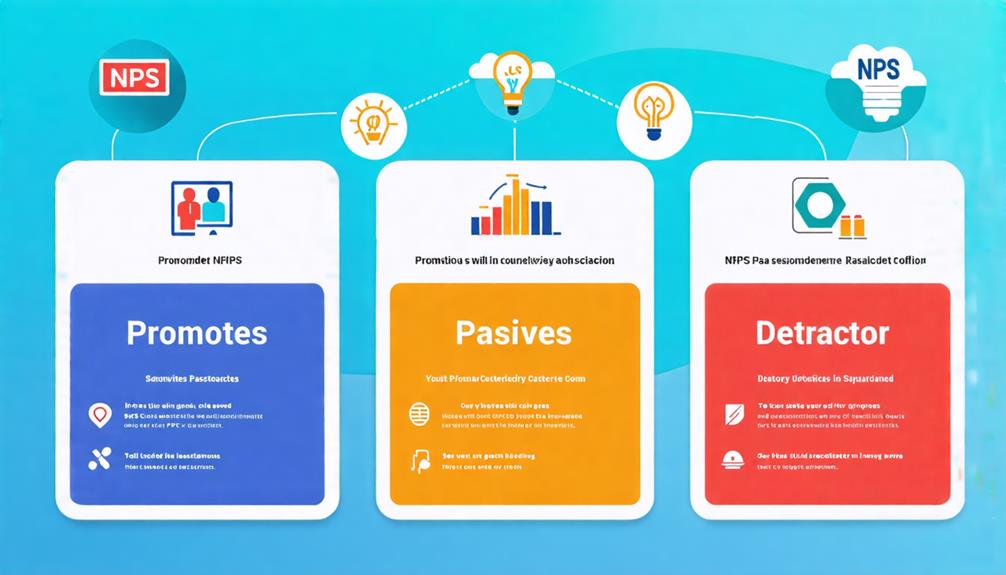
NPS surveys categorize respondents into three distinct groups: Promoters, Passives, and Detractors, each offering valuable insights into customer sentiment and loyalty. Understanding these categories is fundamental for measuring customer loyalty and improving customer relations within your SaaS company.
- Promoters (Score 9-10): These loyal customers are likely to recommend your product, driving organic growth through positive word-of-mouth and referrals. They represent the pinnacle of customer satisfaction.
- Passives (Score 7-8): These customers are satisfied but not enthusiastic. Engaging with them through NPS feedback can help convert them into Promoters, enhancing their overall experience.
- Detractors (Score 0-6): These dissatisfied customers may discourage others from using your product. Addressing their concerns is vital for improving your brand reputation and reducing churn.
Calculating Your NPS
Calculating your Net Promoter Score (NPS) is straightforward and offers crucial insights into customer loyalty. To begin, survey your customers, asking them to rate their likelihood of recommending your product on a scale from 0 to 10. Categorize the responses into three groups: Promoters (9-10), Passives (7-8), and Detractors (0-6).
Next, determine the percentage of Promoters and Detractors. Calculate your NPS by subtracting the percentage of Detractors from the percentage of Promoters. For example, if 60% of your respondents are Promoters and 20% are Detractors, your NPS would be 60% - 20% = 40.
Regularly measuring NPS allows you to track customer satisfaction trends over time. A positive NPS (above 0) is good, while scores above 50 indicate excellent customer loyalty and satisfaction.
Benchmarking NPS Scores

Benchmarking your NPS scores against industry standards offers crucial insights into customer satisfaction and loyalty. By comparing your performance with other SaaS companies, you can pinpoint areas for strategic enhancements and boost customer advocacy.
Here are three key benefits of benchmarking your NPS scores:
- Understand Industry Average: Knowing the typical NPS range for SaaS companies helps you evaluate your performance. For example, an NPS score between 31 and 50 signifies a good level of customer satisfaction, while scores above 60 indicate outstanding customer loyalty.
- Identify Gaps: Regular benchmarking allows you to detect deficiencies in customer satisfaction. If your NPS score is below the industry average, it signals a need for improvement.
- Measure Progress: Continuously tracking NPS scores over time enables you to assess the impact of your customer satisfaction initiatives. This consistent evaluation helps you refine your strategies to better align with customer expectations.
Effective benchmarking not only showcases your current standing but also provides a roadmap for cultivating stronger customer loyalty and advocacy.
Timing for NPS Surveys
When considering the timing for NPS surveys, it's crucial to target moments when users are highly engaged with your product. Conducting surveys shortly after key interactions will provide the most valuable feedback.
Optimal Survey Timing
To gather the most accurate insights, survey users who've recently engaged with your product, ideally 7-14 days after registration. This timing helps capture their initial impressions and gauge satisfaction effectively.
Here are three key strategies for optimal survey timing:
- Transactional NPS Surveys: Send these immediately after key user interactions or feature usage. This provides immediate feedback on specific aspects of your product, enabling prompt improvements.
- Relationship NPS Surveys: Conduct these 30-90 days after users convert to a paid plan. This timeframe helps assess overall customer satisfaction and loyalty, providing a comprehensive view of their experience.
- Follow-Up Surveys: Implement these quarterly after your initial assessments. Continuous tracking of customer sentiment ensures you stay informed about their evolving needs and satisfaction levels.
Avoid surveying inactive users or those not yet activated, as this can lead to annoyance and skew your results negatively.
User Engagement Strategies
How can you effectively engage users through strategic timing of NPS surveys to optimize feedback and improve satisfaction? Timing is crucial for obtaining accurate insights into customer satisfaction and loyalty when conducting NPS surveys. Targeting activated users who've engaged with your product will yield the most relevant feedback.
For immediate insights, deploy transactional NPS surveys following key interactions or feature usage. This approach captures user sentiment in real-time, providing actionable data when the experience is fresh in the user's mind. Conversely, relationship NPS surveys should be conducted 30-90 days after users convert to paid plans. This window allows users ample time to fully experience your service, offering a more comprehensive view of their overall satisfaction.
Regularly conducting these surveys, ideally on a quarterly basis, helps you monitor and analyze changes in NPS over time. This ensures you remain aligned with user behavior and can make informed adjustments to your service. In-app surveys can significantly boost engagement rates as they gather feedback without disrupting the user experience. Integrating these surveys throughout the customer journey provides invaluable insights that can help improve your service and foster lasting customer relationships.
Effective NPS Survey Methods

Implementing in-app surveys immediately following key interactions can significantly enhance engagement and response rates for NPS feedback. Unlike email surveys, which often experience lower participation, in-app prompts capture customer sentiments when they're most relevant.
Consider the following three effective NPS survey methods:
- Transactional NPS Surveys: These surveys assess customer satisfaction after specific actions, such as using a new feature. They provide immediate insights into customer reactions and highlight areas for improvement.
- Relationship NPS Surveys: Conduct these surveys at regular intervals after customers upgrade to paid plans. They offer a broader view of overall satisfaction and customer loyalty over time.
- Personalized Survey Invitations: Customize your invitations with customer names and specific contexts to boost engagement. Personalized invitations tend to yield higher response rates and more accurate feedback.
Furthermore, incorporate open-ended questions in your surveys to gather qualitative feedback, which can reveal deeper insights into customer experiences. Keep surveys concise and focused to reduce respondent fatigue; shorter surveys typically result in higher completion rates and more actionable data.
Analyzing NPS Feedback
Analyzing Net Promoter Score (NPS) feedback uncovers valuable insights that can drive targeted improvements and enhance overall customer satisfaction. By examining open-ended responses, you can identify specific reasons behind your customers' scores, allowing for more precise interventions. Segmenting customers into Promoters, Passives, and Detractors helps recognize patterns in satisfaction and dissatisfaction across different customer segments. This segmentation allows for more tailored and effective responses.
Cross-referencing NPS scores with product usage analytics reveals correlations between customer experiences and feature utilization, guiding you toward upgrades that better meet user needs. Categorizing user feedback based on recurring themes helps prioritize product improvements, ensuring that the most frequently mentioned issues are addressed first.
Regularly tracking changes in NPS over time, alongside qualitative feedback, enables you to measure the effectiveness of implemented changes and their overall impact on customer satisfaction. This ongoing analysis creates a continuous feedback loop, allowing you to refine your offerings based on customer insights consistently.
Enhancing Customer Experience With NPS

Enhancing customer experience through NPS feedback enables you to make informed decisions that directly address your users' needs and concerns. Regularly conducting NPS surveys allows you to gauge customer satisfaction and drive improvements in your SaaS product.
Here's how to leverage NPS for customer experience enhancement:
- Engage with Detractors: Reach out to customers who score you 0-6. Understanding their concerns can reveal critical insights into product misalignments, helping to reduce churn rates and enhance satisfaction.
- Leverage Promoters: Use feedback from those who score 9-10 to elevate your brand's reputation. Their positive word-of-mouth can lead to increased referrals, strengthening customer loyalty.
- Analyze Open-Ended Responses: Explore the qualitative feedback gathered through NPS surveys. This can uncover specific pain points and feature requests, guiding your product development efforts to ensure your offerings align with user needs.
Conclusion
Integrating Net Promoter Score (NPS) into your SaaS strategy can significantly boost customer satisfaction and loyalty. By routinely surveying users, categorizing their responses, and analyzing feedback, you can pinpoint areas for improvement and recognize your strengths.
Engaging with Detractors allows you to address their concerns with actionable solutions, while Promoters can be leveraged as enthusiastic advocates. Continuously monitoring your NPS over time ensures that you consistently meet and exceed customer expectations.
Related posts