
How Does an On-Premise CPQ Solution Compare to a Cloud-Based One?

When comparing on-premise and cloud-based CPQ solutions, consider your needs for control versus convenience. On-premise setups offer extensive customization and data management but require significant IT investment and limit remote access. Cloud-based CPQ offers quick deployment, scalability, and remote accessibility with minimal maintenance, although customization options are more limited. Security is a concern for both, but cloud solutions benefit from vendor-managed infrastructures. Costs diverge as well; on-premise demands a hefty initial outlay, while cloud solutions offer predictable subscription fees. As the market evolves, the agility and innovations of cloud solutions make them increasingly appealing. Explore further to understand what's best for you.
Key Takeaways
- On-premise CPQ requires substantial setup and maintenance, while cloud-based CPQ offers rapid deployment and easy remote access.
- On-premise solutions offer superior data control and customization, whereas cloud solutions have limited customization and data management flexibility.
- Cloud-based CPQ reduces initial costs with a subscription model, unlike the high upfront investment of on-premise solutions.
- On-premise CPQ requires significant IT resources for security, while cloud CPQ benefits from robust vendor security infrastructures.
- Cloud CPQ is expected to dominate the market due to its scalability and adaptability to technological advancements.
Key Differences in Deployment
When evaluating the deployment of CPQ solutions, you'll often notice significant differences between on-premise and cloud-based options. An on-premise CPQ solution requires you to deploy the system within your enterprise's IT infrastructure, which involves a lengthy installation process. This setup demands dedicated IT staff for continuous maintenance and regular updates, adding to the ongoing management responsibilities.
In contrast, cloud-based CPQ solutions streamline deployment, allowing you to set up quickly with minimal involvement from your internal IT team. With cloud-based CPQ, the system is hosted on vendor servers, providing the flexibility of remote access. This means your sales teams and external dealers can access the system from anywhere, creating opportunities for enhanced collaboration and improved workflow efficiency.
On-premise systems, however, typically don't offer this level of remote accessibility, limiting collaboration to within your physical premises. Furthermore, cloud-based CPQ simplifies infrastructure management. The provider handles maintenance, freeing your team from the burden of constant system upkeep, whereas on-premise solutions tie your resources to hands-on management.
Moreover, SaaS ITSM solutions offer similar benefits in terms of scalability and flexibility, enhancing operational efficiency and customer satisfaction through automation and streamlined service management processes. Understanding these deployment differences helps you choose the right CPQ solution that aligns with your organizational needs and capabilities.
Security and Data Management
Security and data management are critical considerations when choosing between on-premise and cloud-based CPQ solutions. On-premise solutions require you to take full responsibility for security measures, including regular backups and internal IT management, to safeguard sensitive information. This approach may appeal to industries like healthcare and finance, where maintaining control over data security and ensuring compliance with regulations are paramount.
However, on-premise systems aren't without risks. They're vulnerable to targeted ransomware attacks, which can compromise your data security.
In contrast, cloud CPQ solutions benefit from the robust security infrastructure provided by vendors like Amazon and Infor. These cloud providers manage a shared security model, potentially offering enhanced protection against such threats, though concerns about data breaches still exist. It is crucial to conduct regular security audits to detect potential vulnerabilities and ensure data protection measures are in place.
When implementing a CPQ solution, consider your organization's capacity to manage data security. On-premise solutions offer direct data access, allowing for extensive data management capabilities. This can be an advantage if you need to tailor security protocols to your specific needs.
Meanwhile, cloud CPQ systems might impose restrictions on data handling and user permissions, which could limit your flexibility but also streamline compliance efforts. Ultimately, weighing these factors is crucial to ensure your CPQ implementation aligns with your security priorities.
Control and Customization Options
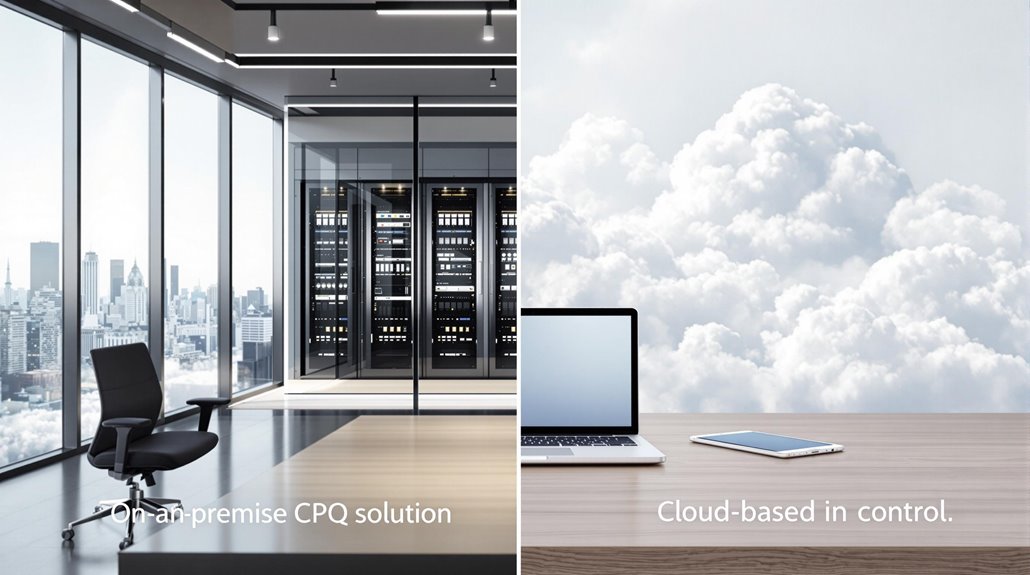
Exploring control and customization options reveals a stark contrast between on-premise and cloud-based CPQ solutions. When you opt for on-premise CPQ solutions, you gain full control over your software and data. This means you can extensively customize beyond standard functionalities, tailoring the solution to meet your organization's unique operational requirements.
You have direct access to data via SQL, enabling advanced data management and reporting, which is a significant advantage for organizations that need deep involvement in customization. It's also essential to consider data governance and management when choosing between these solutions, as on-premise options typically offer more control over data jurisdiction and compliance with local laws.
On the other hand, cloud-based CPQ solutions offer limited control and customization options. These solutions rely on built-in web service rules and connect to cloud APIs, restricting your ability to make extensive modifications.
While user interface design configurations are possible in both environments, cloud solutions often come with limitations compared to the extensive customization available in on-premise setups.
If your organization prioritizes deep customization and comprehensive control, on-premise CPQ solutions are likely more suitable. They allow you to adapt the software to fit your specific needs without the constraints that cloud-based solutions impose.
In contrast, cloud-based CPQ solutions might appeal if you prefer simplicity over extensive customization capabilities.
Cost Implications
While control and customization are key considerations, understanding the cost implications of on-premise versus cloud-based CPQ solutions is equally important. On-premise CPQ solutions demand a hefty upfront investment. You'll need to shell out for licenses, hardware, and infrastructure, which can strain your budget from the get-go.
In contrast, cloud CPQ solutions operate on a subscription fee model, making the initial investment much more manageable. The total cost of ownership (TCO) for on-premise CPQ solutions can catch you off guard. Ongoing maintenance, support, and operational expenses can pile up, often exceeding initial estimates.
With cloud CPQ, you benefit from reduced indirect costs. Downtime and server maintenance become less of a financial burden, enhancing overall financial efficiency. A significant advantage of cloud CPQ is its financial flexibility. You avoid unpredictable operational expenses associated with on-premise solutions, like dedicated IT resources, thanks to predictable monthly fees. This allows you to reallocate funds to other areas of your business.
Here's a quick recap:
- High upfront investment for on-premise CPQ
- Cloud CPQ offers lower initial costs with subscription fees
- Misleadingly high TCO for on-premise CPQ
- Cloud CPQ reduces indirect costs and boosts financial efficiency
- Predictable fees offer financial flexibility in cloud-based solutions
Additionally, integrating a subscription billing system with cloud CPQ can further streamline financial operations by automating invoicing and managing customer charges efficiently.
Scalability and Accessibility

Scalability and accessibility are game-changers when choosing between on-premise and cloud-based CPQ solutions.
With cloud CPQ solutions, you get effortless scalability, allowing your business to adjust user access and accommodate temporary sales support with ease. There's no need for extensive hardware investments, making it perfect for adapting to your company's growth or shifts in seasonal demand.
On the other hand, on-premise CPQ solutions require manual adjustments for capacity changes, which can be cumbersome and less flexible, especially if your business has a fixed product line.
When it comes to accessibility, cloud CPQ solutions shine by offering remote accessibility from any device with WiFi. This means you can configure and price orders from anywhere without being tethered to a single computer.
In contrast, on-premise solutions limit access to the internal network, restricting remote workers and necessitating additional resources to manage external access. This can be a significant drawback when your team needs to operate flexibly or when quick adaptations are necessary.
Thus, cloud CPQ solutions provide a significant advantage over on-premise systems in terms of both scalability and accessibility, ensuring your business stays agile and responsive.
A key feature of cloud solutions is the microservices architecture, which enables independent scaling and deployment of services, allowing businesses to efficiently handle varying loads and maintain high availability.
Market Trends and Future Outlook
As businesses strive to stay agile and responsive, understanding market trends and future outlooks becomes vital. The CPQ software market is evolving, with a projected annual growth rate of 15% through 2020. This reflects the increasing demand for efficient sales processes across both cloud-based and on-premise solutions.
Notably, cloud-based solutions are expected to dominate, transitioning from 25% of the market in 2015 to a significant majority by 2020. The shift is driven by their flexibility and accessibility—crucial factors as businesses adapt to a rapidly changing environment.
The COVID-19 pandemic has accelerated this shift, emphasizing the need for agile tools that support the evolving sales landscape.
You're likely to see:
- Omni-channel solutions enhancing sales quality and customer satisfaction.
- AI and machine learning integrated into CPQ software, boosting automation.
- Highly regulated industries increasingly adopting cloud-based solutions for compliance and efficiency.
- Online retail sales surging, highlighting the demand for responsive sales processes.
- Future innovations focusing on personalization and advanced data analytics.
The future outlook for CPQ software points towards a cloud-centric approach, with technology advancements continuously reshaping how businesses manage their sales processes.
Embrace these trends to stay competitive and responsive. Cloud-based SaaS solutions offer real-time collaboration capabilities, enhancing team productivity and innovation.