
What Is Paas? Platform as a Service

You've probably heard about cloud computing models, but Platform as a Service (PaaS) offers unique advantages that might intrigue you even more. Imagine an all-encompassing environment for developing, deploying, and managing applications without the hassle of handling the underlying infrastructure. PaaS provides integrated development tools, middleware services, and database management systems, all aimed at enhancing productivity and collaboration.
But what makes PaaS truly stand out? How does it compare to other cloud computing models like Infrastructure as a Service (IaaS) and Software as a Service (SaaS)? Moreover, why is it cost-effective for businesses? Let's delve into these questions to gain a clearer understanding.
Definition of PaaS
Platform as a Service (PaaS) is a cloud computing model that offers a comprehensive environment for developing, deploying, and managing applications in the cloud. PaaS provides a complete development framework, enabling developers to focus on building applications without worrying about the underlying infrastructure. This model includes a range of resources such as hosted applications, development tools, database management systems, and security features, all delivered on a pay-as-you-go basis by service providers.
By leveraging PaaS, developers can streamline the entire application lifecycle—from building and testing to deploying and updating—while the platform handles infrastructure complexities. This significantly enhances developer productivity by reducing the need for infrastructure management. Additionally, PaaS supports cross-platform development, allowing applications to run on various operating systems and devices with minimal coding effort.
PaaS pricing models typically offer fixed fees or pay-as-you-go options, making advanced development and analytics tools more accessible and cost-effective for organizations. In summary, PaaS provides an efficient and scalable way to develop, deploy, and manage applications in the cloud, thereby fostering innovation and operational efficiency.
Key Features of PaaS
Imagine having a streamlined workflow where coding, testing, and deploying your application flows seamlessly. That's the power of PaaS. With an integrated development environment (IDE), PaaS simplifies the application lifecycle by providing built-in tools for coding, testing, deployment, and management. This allows you to focus more on development and less on logistical challenges.
PaaS also includes middleware services that enhance communication between different software components, ensuring smooth interoperability within your systems. Robust database management systems efficiently handle data storage and retrieval, eliminating the complexities associated with data management.
Here's a quick overview of key PaaS features:
| Feature | Benefit | Example |
|---|---|---|
| Integrated Development Environment (IDE) | Streamlines the development process | Built-in coding and testing tools |
| Middleware Services | Enhances software integration | Seamless application communication |
| Database Management Systems | Efficient data handling | Automated data storage management |
| Scalable Architecture | Adjusts to application demands | Ideal performance during peaks |
| Pre-built Application Components | Reduces coding effort and speeds up prototyping | Ready-to-use APIs and modules |
Common PaaS Scenarios

Leveraging the robust features of PaaS, let's explore how these capabilities apply to common real-world scenarios. Imagine you're a developer aiming to build or customize cloud-based applications. PaaS provides a development framework with pre-coded components, significantly reducing your coding time and effort. This allows you to concentrate on innovation rather than repetitive coding tasks.
Rapid prototyping is another crucial scenario. With PaaS, you can quickly develop and test your applications, accelerating your time to market. This agility is vital for businesses aiming to maintain a competitive edge in fast-paced industries. Additionally, PaaS solutions often come with powerful analytics tools and business intelligence services. These enable you to analyze data patterns effectively, facilitating informed decision-making and driving your business forward.
Integration capabilities are also a key advantage. PaaS allows seamless integration with existing systems and applications, enhancing operational efficiency. Furthermore, PaaS offers services like workflow automation, directory management, security features, and scheduling capabilities. These enhance your application functionalities and streamline development processes, enabling you to deliver high-quality solutions efficiently. By leveraging PaaS, you can transform your development approach and achieve significant operational improvements.
Advantages of PaaS
One of the standout advantages of Platform as a Service (PaaS) is its ability to significantly reduce coding time. By offering pre-coded application components and integrated development tools, PaaS allows developers to concentrate on creating unique functionalities rather than dealing with foundational code. This streamlines the development process, enabling faster deployment of applications.
PaaS also supports cross-platform development, ensuring that applications run seamlessly on both mobile and web environments. This flexibility broadens the potential user base and guarantees a consistent experience across devices. Coupled with a pay-as-you-go pricing model, PaaS becomes incredibly cost-effective. Businesses of all sizes can access sophisticated development and analytics tools without large upfront investments.
Collaboration is another key benefit. PaaS enhances collaboration by providing internet-based access to a shared development environment. This makes it easier for geographically distributed teams to communicate and manage projects effectively. Additionally, PaaS simplifies scalability. Applications can automatically adjust resources based on demand, efficiently managing user traffic fluctuations without incurring excessive costs.
With these advantages, PaaS emerges as a powerful solution for modern application development in the cloud.
Paas Vs. Iaas and Saas
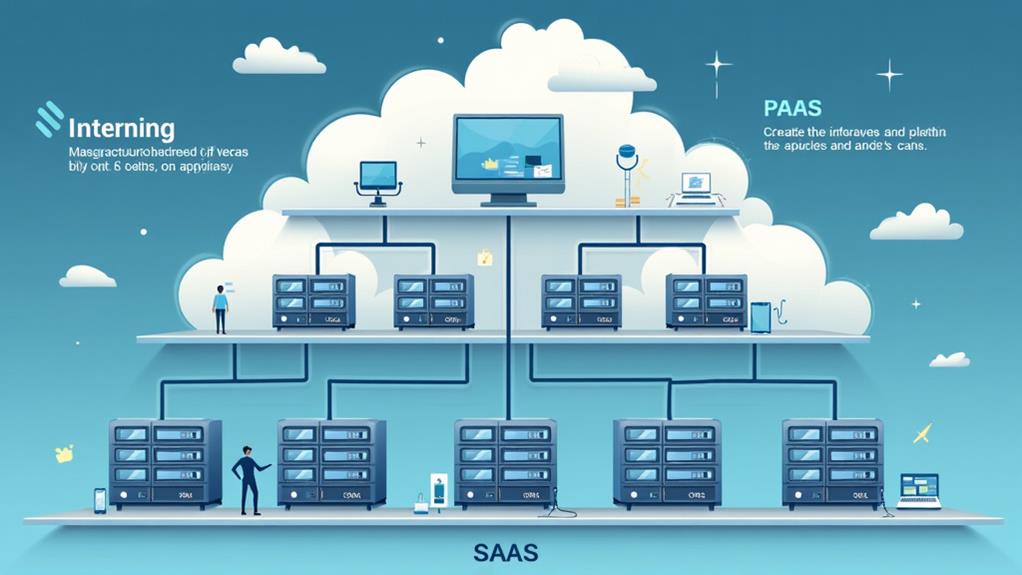
Understanding the key differences between PaaS, IaaS, and SaaS can help you choose the right solution for your specific needs.
Platform as a Service (PaaS) provides a managed environment tailored for developers, offering essential tools and services to build, test, and deploy applications efficiently. Infrastructure as a Service (IaaS) delivers raw computing resources such as virtual machines, storage, and networking, granting users full control over the infrastructure. Software as a Service (SaaS) offers ready-to-use software applications accessible over the internet, eliminating the need for installation and maintenance.
Each model is suited to different scenarios: IaaS is ideal for those requiring granular control over their infrastructure, PaaS is best for streamlined application development, and SaaS is perfect for users seeking complete, turnkey software solutions.
Key Feature Differences
When comparing PaaS to IaaS and SaaS, it's crucial to understand the distinct features each model offers. PaaS provides a comprehensive platform for application development, inclusive of tools for coding, testing, and deployment. This enables development teams to focus on creating custom applications without managing the underlying infrastructure. Conversely, Infrastructure as a Service (IaaS) offers basic infrastructure resources such as virtual machines and storage, requiring users to handle their own operating systems and software installations.
PaaS facilitates collaboration among development teams and streamlines the application lifecycle, making it ideal for rapid application development. It typically includes integrated development environments and middleware for application integration, which are not available in IaaS solutions. This makes PaaS more suitable for developers needing a cohesive environment for coding and testing.
Unlike SaaS, which delivers fully functional software applications over the internet, PaaS empowers developers to build and deploy their own applications. While SaaS users receive ready-to-use software, PaaS users gain a flexible platform that simplifies the complexities of application development, ensuring quicker time-to-market and more efficient resource utilization.
Use Case Scenarios
Imagine navigating a landscape filled with diverse business needs and technological demands—this is where PaaS, IaaS, and SaaS each find their unique roles.
Platform as a Service (PaaS) stands out by offering a complete development environment in the cloud. As a developer, you can focus on application development without worrying about managing the underlying infrastructure. Pre-coded components and integrated services facilitate rapid development and deployment, saving you time and effort.
In contrast, Infrastructure as a Service (IaaS) provides raw infrastructure resources, requiring you to manage the operating system and applications. This is beneficial if your business needs custom configurations and control over the environment but adds operational complexity. IaaS is ideal for businesses that want to construct a custom infrastructure from the ground up.
On the other hand, Software as a Service (SaaS) delivers fully functional applications over the internet. This model is perfect if you need ready-to-use software without the hassle of development or customization. SaaS is designed for organizations seeking quick, hassle-free access to software solutions.
In essence, PaaS is tailored for developers aiming to build and deploy applications quickly, IaaS suits businesses needing robust, customizable infrastructure, and SaaS meets the needs of those seeking turnkey software solutions.
Key Components of PaaS
At the core of Platform as a Service (PaaS) are several essential components designed to streamline the development and deployment of cloud-based applications. PaaS offers an integrated suite of development tools for coding, testing, and deploying applications, enhancing productivity and collaboration among development teams by eliminating the need to manage underlying infrastructure.
Database management services within PaaS enable efficient data storage, access, and integration. These services ensure your applications interact seamlessly with various data sources, allowing you to focus more on development rather than database complexities.
Security features are another critical component of PaaS. Built-in security measures, such as networking firewalls, protect your applications and data from potential threats while ensuring compliance with industry standards. This enables you to develop and deploy applications with confidence, knowing they are secure.
Furthermore, PaaS leverages physical infrastructure housed in data centers, providing the necessary servers, storage, and networking resources. This robust infrastructure supports the development and execution of your applications, ensuring smooth and efficient deployment.
Types of PaaS Solutions

Organizations have diverse needs, which is why various types of PaaS solutions exist. Public PaaS offers a multi-tenant environment, ideal for developers seeking flexible and cost-efficient cloud services. It allows control over software deployment without the burden of managing infrastructure.
Private PaaS, on the other hand, is designed for single organizations needing dedicated resources. It is ideal for businesses with stringent data privacy requirements, as it ensures enhanced security and compliance.
Hybrid PaaS combines public and private capabilities, enabling efficient workload management across different environments. This approach is beneficial for balancing cost and control.
Specialized PaaS solutions cater to specific needs. CPaaS focuses on communication functionalities, mPaaS targets mobile app development, and iPaaS addresses integration solutions, each tailored to specific application lifecycle challenges.
PaaS Use Cases
PaaS is invaluable for accelerating development by enabling rapid build, test, and deployment of applications without the hassle of managing underlying infrastructure. It facilitates seamless integration with various services, enhancing overall connectivity and functionality. Additionally, PaaS supports scalable solutions, simplifying the management and updating of applications as your requirements evolve.
Development Acceleration
Platform as a Service (PaaS) significantly accelerates development cycles by providing pre-built application components and integrated tools that reduce coding requirements and streamline the entire development process. This allows for rapid prototyping, enabling quick creation, testing, and iteration of applications without the need to manage underlying infrastructure, thereby allowing developers to focus on innovation.
PaaS's integrated tools facilitate the adoption of microservices architectures, enabling the construction of modular applications that can be independently deployed and scaled to meet varying demands efficiently. A key benefit is the inclusion of continuous integration and continuous deployment (CI/CD) capabilities, which automate testing and deployment processes. This not only reduces time to market but also ensures consistently high-quality applications.
Additionally, PaaS is ideal for developing APIs and IoT applications, offering the necessary tools and services to seamlessly connect and manage diverse systems and devices. By reducing coding requirements and simplifying deployment processes, PaaS enables faster and more efficient application development.
Seamless Integration
Seamless integration is a standout feature of Platform as a Service (PaaS), enabling businesses to effortlessly connect public, private, and on-premises applications. PaaS leverages Integration Platform as a Service (iPaaS) to facilitate seamless integration across diverse environments, enhancing data flow and operational efficiency for smoother and more reliable workflows.
Developers particularly benefit from PaaS in API development and management. Standardized interfaces ensure applications interact seamlessly, while support for microservices architecture allows for the creation of modular applications that communicate effectively with each other and external services. This modular approach is crucial for building efficient and cohesive systems.
Out-of-the-box connectors and middleware services further simplify the integration process, reducing the time and resources needed to connect various applications and services. This allows businesses to focus on core operations and innovation. By leveraging PaaS, integration becomes straightforward, setting the stage for improved data flow and operational efficiency, ultimately driving business growth.
Scalability Solutions
Scalability solutions are an essential feature of PaaS, enabling applications to seamlessly adapt to varying user demands. With PaaS, infrastructure adjustments during traffic spikes are handled automatically, ensuring your applications operate efficiently and reliably.
Here are four key benefits of PaaS scalability solutions:
- Automatic Scaling: PaaS platforms dynamically adjust application resources based on user demand. This capability allows you to manage peak times or promotional events without manual intervention, ensuring a seamless user experience.
- Built-in Load Balancing: Many PaaS providers offer load balancing features that distribute traffic evenly across multiple servers. This enhances application performance and reliability by preventing any single server from becoming a bottleneck.
- Microservices Support: PaaS platforms support a microservices architecture, enabling the independent scaling of individual application components. This optimizes resource usage and can significantly reduce operational costs.
- Global Deployment: With PaaS, you can deploy applications across multiple data centers worldwide. This ensures low latency and high availability for users globally, enhancing their overall experience.
Leading PaaS Providers

When exploring leading PaaS providers, you'll encounter a variety of powerful options tailored to diverse development needs. Google App Engine offers a fully managed serverless platform that simplifies building and hosting scalable web applications. It supports multiple programming languages and frameworks, with automatic scaling based on demand, making it ideal for dynamic application infrastructure.
Microsoft Azure distinguishes itself with a comprehensive suite of cloud services, including robust PaaS capabilities. As a global cloud service provider, Azure allows you to build, deploy, and manage applications through an extensive network of data centers, ensuring high availability and performance.
Heroku is recognized for its developer-friendly approach, streamlining the deployment process. It integrates with numerous add-ons and services, enhancing functionality for your applications.
IBM Cloud Foundry offers a flexible environment for developing, deploying, and managing applications. It supports various programming languages and frameworks while providing extensive tools for continuous integration and delivery.
Red Hat OpenShift leverages Kubernetes for container orchestration, enabling secure and efficient building, deployment, and scaling of applications. This enterprise-grade PaaS is a strong contender in the market.
Each of these PaaS providers offers unique features to meet specific development needs, ensuring semantic interoperability and trustworthy solutions for your projects.