
Top KPIs for SaaS Companies to Monitor

When managing a SaaS business, knowing which key performance indicators (KPIs) to track can significantly impact your growth strategy. Metrics like Churn Rate and Customer Lifetime Value offer valuable insights into customer retention and profitability. However, by also focusing on other critical metrics, you can gain a more comprehensive understanding of your revenue and improve customer satisfaction.
Let's explore these essential KPIs and their implications for your business.
Importance of Monitoring KPIs
Monitoring Key Performance Indicators (KPIs) is essential for SaaS companies as it enables the assessment of performance relative to goals, facilitating informed decision-making that drives growth.
By closely tracking metrics such as customer churn rate, lifetime value (LTV), and monthly recurring revenue (MRR), companies can glean insights into customer satisfaction and overall business health. This data-driven approach helps identify trends affecting revenue stability and highlights areas needing improvement.
Effective KPI monitoring promotes transparency within the organization, allowing teams to clearly understand performance expectations and outcomes. When employees recognize how their contributions impact KPIs, it boosts accountability and engagement, leading to a more motivated workforce. Additionally, visualizing performance data through dashboards makes complex information accessible, fostering a data-driven culture.
Focusing on critical KPIs enables strategic decisions that enhance customer retention and satisfaction, laying the foundation for long-term success. Routine KPI analysis ensures that companies aren't merely reacting to issues but proactively shaping their future.
Key Customer Retention Metrics
Understanding key customer retention metrics is crucial for SaaS companies aiming to boost customer loyalty and minimize churn.
The Churn Rate measures the percentage of customers canceling subscriptions. Keeping this rate below 5% annually is vital for sustainability. Analyzing the Revenue Churn Rate provides deeper insight into revenue loss from cancellations, helping identify high-value customers at risk.
Customer Lifetime Value (CLV) is another important metric, reflecting long-term profitability. Aim for a CLV at least four times higher than your Customer Acquisition Cost (CAC) to ensure a healthy return on investment.
A strong Net Promoter Score (NPS) of 50 or above indicates high customer loyalty and satisfaction, both key factors in reducing churn.
Regularly tracking these metrics allows you to develop effective retention strategies and address issues leading to high churn rates. Focusing on customer satisfaction and loyalty will help create a more resilient business model and improve overall customer retention.
Essential Revenue Metrics
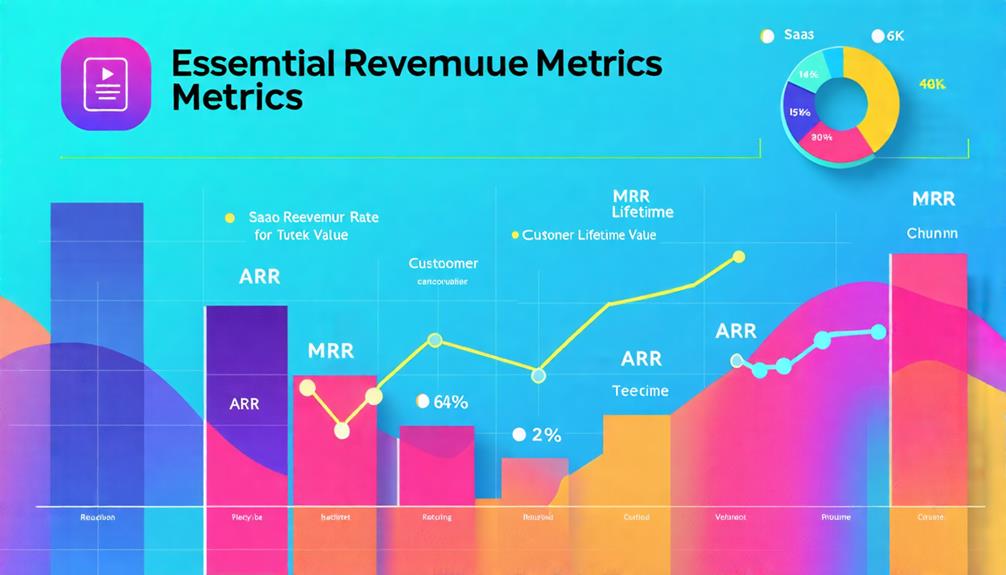
Understanding Monthly Recurring Revenue (MRR) and Annual Recurring Revenue (ARR) is crucial for the growth and financial health of your SaaS business. MRR provides a clear view of predictable monthly income, while ARR offers insight into long-term revenue stability. These metrics guide strategic decisions and enhance forecasting capabilities, ensuring sustainable business operations.
Monthly Recurring Revenue (MRR)
Monthly Recurring Revenue (MRR) is critical for assessing the financial stability and growth potential of SaaS companies. It reflects the predictable income generated from subscriptions, serving as a key metric for evaluating your business's financial health.
To calculate MRR, multiply the total number of active subscription accounts by the average revenue per account. This calculation helps track revenue growth and forecast future income. Monitoring MRR enables you to identify various factors affecting your revenue, such as:
- Customer Acquisition Cost (CAC)
- Customer Lifetime Value (CLV)
- Churn Rate
Annual Recurring Revenue (ARR)
Annual Recurring Revenue (ARR) is a vital metric for evaluating the long-term financial health and growth potential of your SaaS company. By calculating ARR—multiplying Monthly Recurring Revenue (MRR) by 12—you can reliably forecast future income. This metric not only highlights your revenue growth rate but also offers insights into customer satisfaction and retention.
Monitoring ARR helps gauge the effectiveness of your customer success strategies. A growth rate in ARR between 20% and 40% year-over-year typically indicates a thriving SaaS business model and a strong market presence. Additionally, breaking down ARR into components such as new sales, upsells, and churn provides a deeper understanding of your revenue dynamics.
Utilize this information to refine your strategies, focusing on customer retention and minimizing churn. Consistent ARR growth signals effective service delivery and customer loyalty. Prioritize initiatives that enhance customer satisfaction to ensure sustained success and profitability.
Customer Acquisition Metrics
Customer acquisition metrics are essential for evaluating the effectiveness of your SaaS company's efforts to attract and convert new customers. Monitoring these metrics allows you to refine your sales and marketing strategies for optimal revenue growth.
Here are four crucial metrics to focus on:
- Customer Acquisition Cost (CAC): This metric measures the total cost spent on sales and marketing divided by the number of new customers acquired. Ensuring a low CAC relative to Customer Lifetime Value (CLV) is key to maintaining profitability.
- Lead Velocity Rate (LVR): This indicates the month-over-month growth rate of qualified leads in your sales pipeline. A stable or increasing LVR signals a robust and healthy pipeline.
- Conversion Rate: This metric represents the percentage of leads that convert into paying customers, with a good benchmark being between 2% to 4%.
Additionally, focusing on Product-Qualified Leads (PQLs)—leads who've demonstrated meaningful engagement with your product—can provide valuable insights into those most likely to convert.
Financial Health Indicators
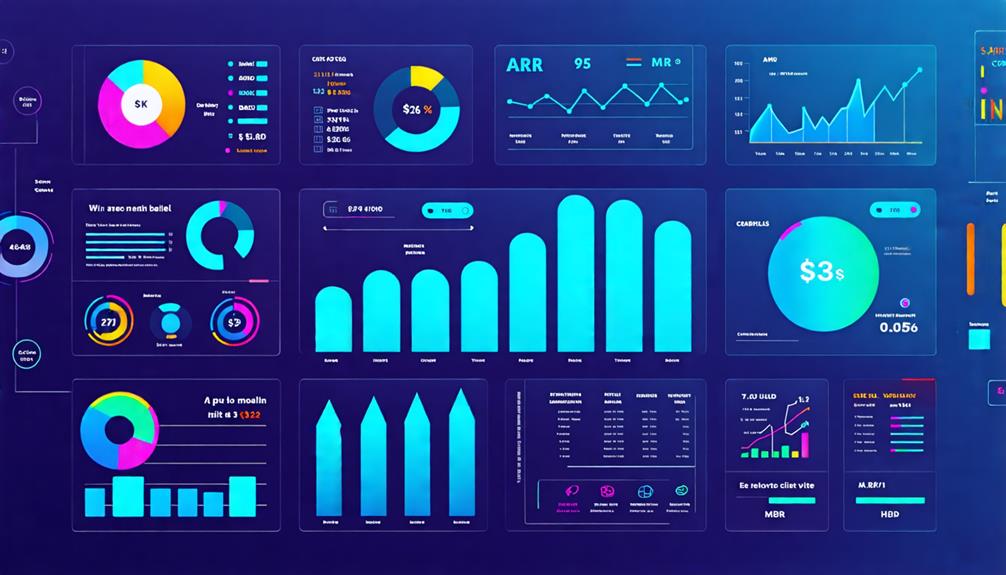
Understanding the financial health of your SaaS company is as crucial as tracking customer acquisition metrics, as it reveals your business's sustainability and growth potential. Key performance indicators such as Monthly Recurring Revenue (MRR) and Annual Recurring Revenue (ARR) are fundamental for measuring predictable and long-term revenue streams. MRR helps forecast future income, while ARR provides a clearer picture of financial stability.
Customer Acquisition Cost (CAC) is another significant metric, calculating the total expenses associated with acquiring new customers. Ideally, this should be balanced with Customer Lifetime Value (CLV) to ensure sustainable profitability.
Don't overlook the Churn Rate, which indicates the percentage of customers lost over time. A high churn rate signals potential issues with customer satisfaction and directly impacts your revenue.
Customer Satisfaction Measurements
Measuring customer satisfaction is crucial for SaaS companies aiming to enhance customer loyalty and improve user experience. By leveraging key metrics, you can gain valuable insights into how your customers perceive your service.
Focus on these essential measurements:
- Net Promoter Score (NPS): This metric gauges customer loyalty by subtracting the percentage of detractors from the percentage of promoters. A score above 50 indicates strong customer loyalty.
- Customer Satisfaction Score (CSAT): Gather immediate feedback via surveys, asking customers to rate their satisfaction on a scale of 1 to 5. Scores of 4 or 5 reflect high satisfaction.
- Customer Effort Score (CES): This metric evaluates how easy it is for customers to interact with your service. A lower score indicates a smoother user experience, which is critical for customer retention.
Leveraging Actionable Insights

To fully leverage actionable insights, prioritize data-driven decision-making to shape your strategies. Embrace continuous improvement and proactive engagement to enhance customer satisfaction and retention. This approach not only boosts performance but also fosters sustainable growth for your SaaS company.
Data-Driven Decision Making
Data-driven decision making in SaaS thrives on actionable insights from key performance indicators, enabling informed choices that promote growth and customer retention. By focusing on metrics like Monthly Recurring Revenue (MRR) and Customer Lifetime Value (CLV), you can ensure revenue stability and long-term profitability. Regularly monitoring your Churn Rate and Net Promoter Score (NPS) helps identify potential retention issues early.
To utilize these insights effectively, consider these strategies:
- Utilize dashboards for KPI visualization to enhance transparency and accountability among your team.
- Analyze Lead Velocity Rate (LVR) regularly to forecast future sales revenue and adjust strategies proactively.
- Optimize Customer Acquisition Cost (CAC) through targeted marketing strategies to amplify return on investment.
Continuous Improvement Strategies
Continuous improvement in your SaaS company hinges on leveraging actionable insights to refine processes and enhance customer experiences. Start by regularly reviewing key performance indicators (KPIs) such as churn rate and customer lifetime value (CLV) to identify trends and inform retention strategies. Reducing churn not only boosts customer satisfaction but also increases CLV.
Utilize insights from Net Promoter Score (NPS) surveys to gauge customer sentiment. This feedback can guide informed adjustments to your products or services, fostering loyalty and advocacy. Establish a continuous feedback loop by integrating mechanisms for capturing customer feedback, ensuring it directly influences product development and service improvements.
Visualize KPIs with dashboards for real-time insights, enabling quick decisions to address performance issues. Commit to regular benchmarking against industry standards to evaluate your performance. This practice helps identify areas for continuous improvement and ensures your strategies remain relevant in the fast-evolving SaaS landscape.
Proactive Engagement Initiatives
Leveraging actionable insights from customer feedback can significantly enhance your proactive engagement initiatives, ultimately reducing churn and boosting satisfaction. By focusing on key metrics like Net Promoter Score (NPS) and Monthly Recurring Revenue (MRR), you can identify at-risk customers and intervene before issues escalate.
Here are some crucial strategies to augment your proactive engagement:
- Analyze Customer Lifetime Value (CLV) alongside Customer Acquisition Cost (CAC) to prioritize high-value clients.
- Regularly monitor churn rate and revenue churn rate to spot trends and adjust your retention initiatives accordingly.
- Utilize lead velocity rate (LVR) data to nurture qualified leads effectively, thereby increasing conversion rates.
These strategies not only help maintain customer satisfaction but also contribute to a healthier bottom line. By investing in proactive engagement, you set the stage for long-term relationships, driving growth and profitability. Addressing customer concerns before they escalate fosters loyalty and ensures a stable revenue stream for your SaaS business.
Role of Dashboards
How can dashboards transform the way SaaS companies visualize and act on their key performance indicators (KPIs)? Dashboards offer a powerful and intuitive visual representation of critical KPIs, streamlining the interpretation of complex data and facilitating strategic decision-making. With customizable dashboards, organizations can prioritize the most pertinent metrics, fostering enhanced engagement and ongoing improvement.
Here's an overview of how dashboards can impact SaaS operations:
| Aspect | Benefits | Impact on Outcomes |
|---|---|---|
| Real-Time Insights | Instant data access | Agile and informed decision-making |
| Customizable Metrics | Metrics tailored to specific needs | Sharper focus on business priorities |
| Accountability | Regular metric reviews | Enhanced team performance |
| Data-Driven Culture | Promotes understanding across teams | Improved cross-functional collaboration |
| Customer Success | Responsive to customer feedback | Elevated customer satisfaction and retention |
Centralizing KPI Data

Centralizing KPI data from diverse sources aligns your organization's performance tracking across all departments. By consolidating data, you create a unified approach that enhances informed decision-making and supports strategic planning. This transformation fosters a data-driven culture, enabling your team to focus on critical business growth areas.
Key benefits of centralizing KPI data include:
- Consistency: Ensures all departments, from sales to customer support, are aligned on performance metrics.
- Transparency: Regular reviews enhance openness in KPI reporting processes, boosting employee engagement and accountability.
- Trend Identification: Centralized tracking enables the identification of trends and performance gaps, guiding strategic direction.
Conclusion
In summary, monitoring key performance indicators (KPIs) is crucial for the success of your SaaS company. By tracking metrics such as customer retention, revenue, customer acquisition costs, and customer satisfaction, you can make data-driven decisions that foster growth.
Leverage actionable insights from your data and use centralized dashboards to consolidate your KPI information. This proactive approach enhances your understanding of business performance, enabling you to address challenges and capitalize on opportunities effectively.
Stay focused, and watch your company thrive!