
How to Calculate Lifetime Value of a SaaS Customer

Calculating the Lifetime Value (LTV) of a SaaS customer involves more than simple arithmetic; it requires a deep understanding of the customer journey and their long-term financial impact. Begin by determining the Average Revenue Per User (ARPU) and estimating the customer lifespan. Once you have these figures, the next step is to integrate these insights into your business strategy. By analyzing the nuances of LTV, you can make informed decisions on customer acquisition and retention. Let's delve into the detailed steps.
- Calculate ARPU: Determine the average revenue generated per user over a specific period.
- Estimate Customer Lifespan: Predict how long a customer will remain with your service.
- Compute LTV: Multiply ARPU by the estimated customer lifespan.
- Incorporate Insights: Use LTV data to refine marketing strategies, optimize customer service, and improve product offerings.
By understanding and leveraging LTV, you can enhance your approach to customer acquisition and retention, ultimately driving sustainable growth.
Understanding Customer Lifetime Value
Understanding Customer Lifetime Value (CLV) is essential for any SaaS business aiming for long-term success. CLV measures the total revenue a customer is expected to generate throughout their relationship with your company, providing insights into profitability and sustainability. By knowing your Average Revenue Per User (ARPU) and Customer Lifespan, you can calculate CLV, helping you evaluate if your Customer Acquisition Cost (CAC) aligns with sustainable growth.
CLV is not limited to historical data; it also includes predictive CLV, which uses past trends to estimate future value. This approach allows you to craft proactive marketing strategies targeting high-value customer segments. For instance, if you identify a segment with a high retention rate, you can allocate more resources to retain those customers, thereby enhancing overall satisfaction.
Moreover, tracking CLV enables you to tailor your marketing efforts effectively. Understanding which customers are most valuable allows you to create personalized strategies to increase retention and satisfaction. Ultimately, understanding CLV helps you allocate resources wisely, ensuring sustainable growth and long-term profitability for your business.
Basic LTV Calculation
Calculating the basic Lifetime Value (LTV) of a SaaS customer is essential for your business strategy, as it helps you understand the potential revenue from each customer, which in turn guides your marketing and retention efforts.
Follow these three steps:
- Calculate ARPU: Divide your Monthly Recurring Revenue (MRR) by the total number of active users. This gives the average revenue generated per user.
- Estimate Customer Lifespan: Determine the Customer Lifespan by taking the inverse of your monthly churn rate. For example, if your churn rate is 5% per month, the Customer Lifespan is 20 months (1 / 0.05).
- Factor in Gross Margin: Calculate your Gross Margin by subtracting the cost of goods sold (COGS) from your revenue and dividing the result by the revenue. This reflects the actual profit from each customer.
To calculate LTV, multiply ARPU by the Customer Lifespan and adjust for Gross Margin. For instance, if ARPU is $50, Customer Lifespan is 20 months, and Gross Margin is 60%, your LTV would be $600 ($50 * 20 * 0.60).
Understanding these basics ensures you are better equipped to manage customer retention, optimize your Customer Acquisition Cost (CAC), and enhance your SaaS revenue.
Advanced LTV Methods
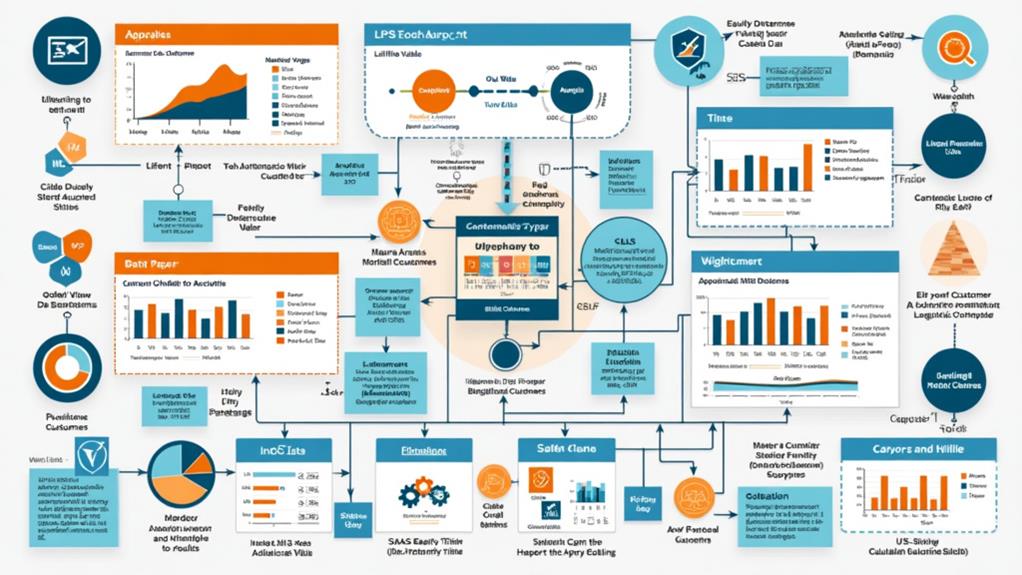
Exploring advanced Lifetime Value (LTV) methods reveals several innovative approaches to enhance business insights and strategies. One effective technique is Cohort Analysis, which segments customers based on shared characteristics or behaviors. This enables you to track LTV over time, identify trends, and tailor marketing strategies for specific groups.
Predictive Analytics goes a step further by leveraging historical data and machine learning to forecast future revenue from customers. This approach provides a dynamic understanding of customer value based on behavioral patterns, significantly enhancing strategic planning.
The Discounted Cash Flow (DCF) method estimates future cash flows from a customer and discounts them to present value, accounting for the time value of money. This method offers a more precise representation of revenue potential.
Incorporating churn rate into your LTV calculations is crucial. For instance, LTV can be calculated as ARPU (average revenue per account) divided by the churn rate, providing insights into customer lifespan and aiding in the development of retention strategies.
Additionally, considering gross margin in your LTV calculations ensures that revenue estimates reflect actual profit, leading to more informed financial decisions. Mastering these advanced LTV methods can help your SaaS business optimize customer acquisition costs and drive sustainable growth.
Importance of LTV for SaaS
Understanding and leveraging the lifetime value (LTV) of a SaaS customer is not just a metric but a strategic cornerstone for your business. LTV estimates the total revenue expected from a customer throughout their subscription, guiding decisions on customer acquisition costs (CAC) and resource allocation. A healthy LTV to CAC ratio is typically 3:1, meaning for every dollar spent on acquiring a customer, three dollars are generated in revenue over the customer's lifetime.
Accurately calculating LTV allows you to identify profitable customer segments, enabling more effective marketing strategies for enhanced customer retention. Research indicates that increasing customer retention rates by just 5% can result in profit increases ranging from 25% to 95%. This highlights the importance of LTV in driving customer loyalty and reducing churn.
Here's why LTV is fundamental for SaaS companies:
- Resource Allocation: Ensures efficient resource distribution to maximize revenue.
- Marketing Strategies: Facilitates targeted marketing efforts that improve customer retention.
- Customer Relationship Management: Refines management practices to boost long-term profitability.
Strategies to Increase LTV

Enhancing the lifetime value (LTV) of your SaaS customers involves implementing actionable strategies that focus on fostering deeper customer relationships and maximizing revenue per user. One effective approach is promoting upselling and cross-selling. By analyzing customer usage patterns and preferences, you can identify opportunities to offer additional features or services, leveraging the fact that existing customers are 60-70% more likely to make a purchase compared to new customers.
Improving customer retention is crucial. Invest in exceptional customer support and proactive engagement strategies. Retaining just 5% more customers can increase profits by at least 25%. Implementing loyalty programs is another powerful strategy. Rewarding long-term customers not only strengthens their relationship with your brand but also can lead to a 10-30% increase in customer lifetime value.
Optimizing your pricing strategies is essential. Regularly evaluate your subscription models and offer flexible plans that align with customer needs. This approach can improve retention rates and boost LTV. Personalized onboarding and continuous education are also key components. Demonstrate your product's value from the start and maintain engagement to reduce churn rates and increase customer satisfaction.
Community and Resources for SaaS Founders
Joining a community of over 64,000 SaaS founders grants you access to valuable weekly growth advice and insights into industry trends. SaaS Academy offers extensive resources, including webinars with industry experts to help you optimize your operations. Networking within this community allows you to connect with like-minded individuals, fostering collaborative growth through shared experiences.
Growth Advice Network
Navigating the complexities of the SaaS industry is challenging, but a dependable support network can make a significant difference. The Growth Advice Network, a community of over 64,000 SaaS founders, is an invaluable resource offering weekly insights on growth strategies, industry trends, and networking opportunities tailored to SaaS businesses.
As a member, you'll gain access to extensive resources, including guides on SaaS metrics, case studies, and expert webinars. These tools are crucial for calculating Lifetime Value (LTV), managing Customer Acquisition Cost (CAC), and addressing revenue churn rate. Detailed guidance is available to help you increase customer lifetime value and total revenue by understanding and retaining valuable customers.
Here's what you can expect:
- Growth Sessions: Free personalized growth sessions and customized action plans for B2B SaaS founders with over $10K MRR.
- Engagement Platforms: Opportunities to share feedback, experiences, and best practices with fellow SaaS founders to foster collaboration.
- Expert Scale Specialists: Access to experts for personalized advice to improve your Customer Lifetime Value and overall business performance.
Joining the Growth Advice Network will equip you with the knowledge and tools necessary for successful B2B SaaS marketing and sustaining valuable customer relationships.
Expert Insights Webinars
For those eager to deepen their understanding of customer lifetime value (LTV), the Expert Insights Webinars offer an invaluable resource. These sessions provide SaaS founders with direct access to industry experts who share best practices and strategies for LTV calculation. You'll delve into various methods, from predictive analysis to cohort-based approaches, enhancing your comprehension of customer profitability.
The webinars include real-world case studies that illustrate how precise LTV calculations can revolutionize your marketing strategies and lower your customer acquisition costs (CAC). Additionally, interactive Q&A sessions offer personalized insights tailored to your unique SaaS business model and challenges.
Here's a brief overview of what you can expect:
| Feature | Benefit |
|---|---|
| Expert-led sessions | Learn from industry leaders |
| Predictive analysis methods | Enhance SaaS analytics and customer profitability |
| Real-world case studies | Implement proven strategies in your business |
| Interactive Q&A sessions | Gain personalized insights and advice |